
The Almost-All-Rounder
The Impact Player rule did not ask the IPL to stop producing all-rounders. It stopped asking them to bowl.


Part 2 of this series ended with a claim: the all-rounder is disappearing from the IPL. Not by accident. By design.
That claim needs precision. All-rounders have not vanished from IPL squads. What the data shows is more specific, and in some ways more troubling: the IPL has reduced how much it asks its top-seven batters to bowl. The rule has not removed the dual-skill cricketer. It has made the bowling half of that skill progressively easier to leave unused.
This is the evidence.
Start with the overs, not the labels
Before arguing about who is or is not an all-rounder, look at what top-seven batters are actually doing with the ball.
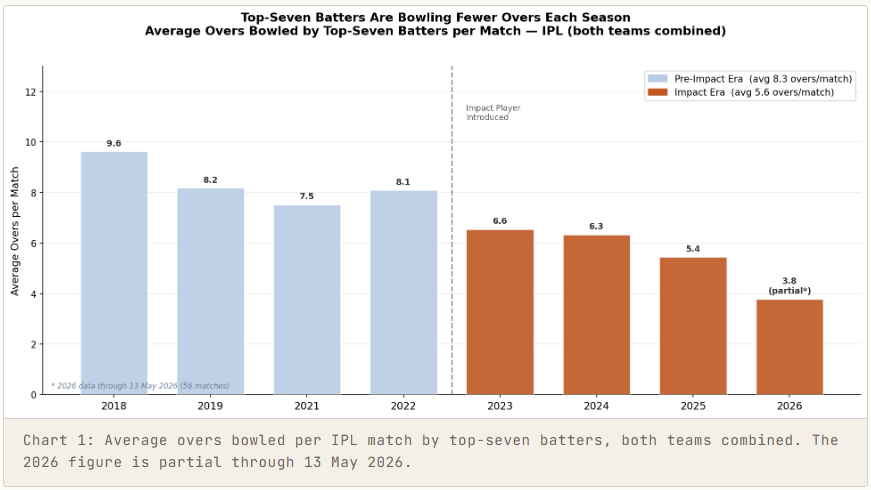
In the pre-impact era, covering IPL seasons 2018 to 2022 and excluding the UAE season of 2020, top-seven batters bowled an average of 8.3 overs per match across both teams. In the impact era that figure has fallen to 5.6. By 2026 it stands at 3.8. The 2026 figure covers 56 matches through 13 May 2026 and should be read as directional, but it is consistent with every preceding season in the impact era.
The direction is hard to miss. Within the impact era: 6.6 in 2023, 6.3 in 2024, 5.4 in 2025, 3.8 in the partial 2026 sample. The partial 2026 figure pushes the trend further in the same direction.
These figures differ from the longer historical figures cited in Part 1 of this series, which used Vishal Misra’s dataset spanning all IPL seasons from 2008. The narrower 2018 to 2026 window here gives a more like-for-like comparison between the two eras. The direction of the finding is identical.
The cross-league test
Part 2 established a principle: if a finding is driven by global T20 evolution rather than a specific rule change, it should appear comparably across leagues without the rule. The same top-seven bowling usage test was run across the IPL, Big Bash League, and T20 Blast.
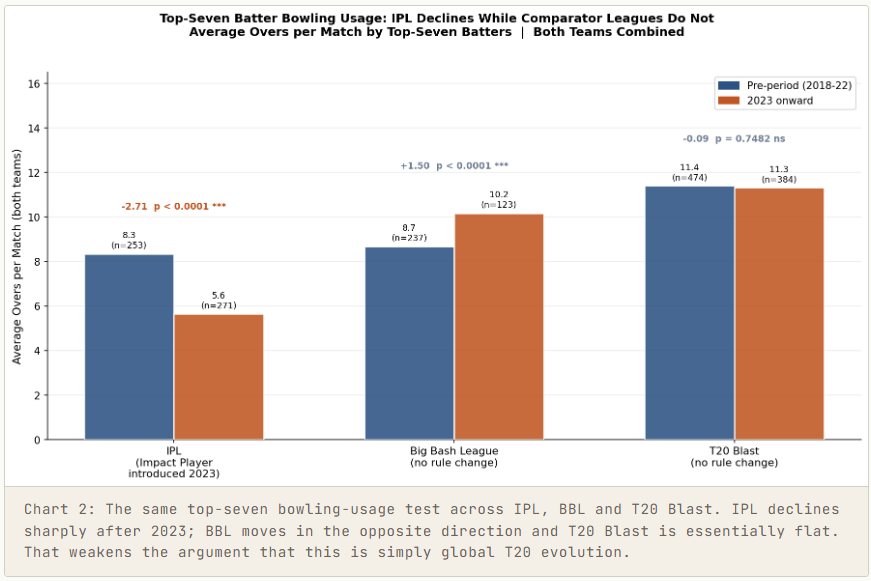
The IPL shows a decline of 2.71 overs per match, significant at p < 0.0001. The T20 Blast shows a change of 0.09 overs. Essentially flat, not significant. And the BBL shows an increase of 1.50 overs per match, also significant at p < 0.0001.
Among the three leagues tested, the IPL is the only one in which top-seven batter bowling usage is falling. The BBL moved in the opposite direction over the same period. That matters less as a story about Australian cricket than as a control: it argues against the idea that all T20 leagues are naturally moving away from top-seven bowling. In this sample, the decline is specific to the league that changed its rules.
The role spectrum is shifting
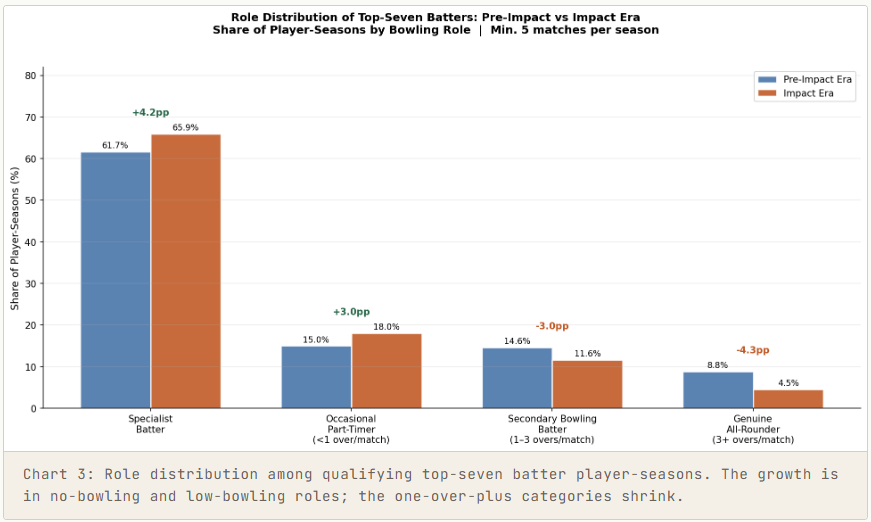
The aggregate decline in overs reflects a specific pattern in role distribution. Across 274 qualifying player-seasons in the pre-impact era and 311 in the impact era, the share of genuine all-rounder player-seasons (defined as averaging three or more overs per match) has fallen from 8.8% to 4.5%. In raw numbers: 24 qualifying genuine all-rounder player-seasons before the rule, 14 in the impact era.
The secondary bowling batter category (players averaging one to three overs per match) has also declined, from 14.6% to 11.6% of player-seasons.
The growth is in the categories that carry little or no bowling responsibility. Specialist batters grew from 61.7% to 65.9%. Occasional part-timers (averaging less than one over per match) grew from 15.0% to 18.0%. The one-over-plus categories shrank. The no-bowling and low-bowling categories grew.
The fair counterargument is that part-time bowling was already under pressure before 2023. T20 has become more specialised everywhere. Captains trust matchups more precisely, analysts identify weaknesses more sharply, and poor part-time overs are punished harder. But the Impact Player rule changes the cost-benefit calculation in a way that ordinary specialisation pressure does not. It gives teams an extra mechanism to act on specialisation without penalty. The rule does not cause specialisation. It removes the last structural reason to resist it.
What the data looks like in individual careers
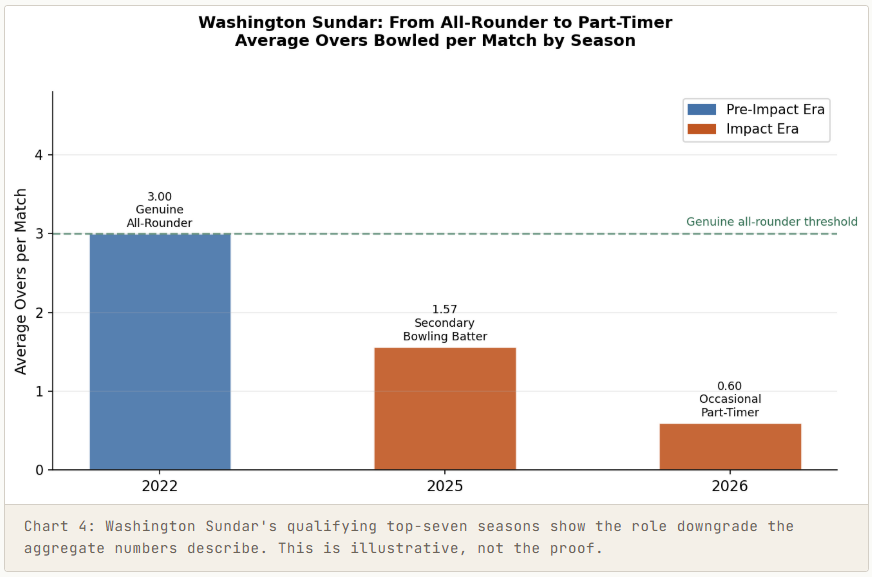
Washington Sundar’s career across three qualifying IPL seasons is the sharpest illustration of what the usage data describes.
In 2022 he averaged exactly three overs per match, a genuine all-rounder on the threshold of meaningful bowling contribution from the top order. In 2025, his first full impact era season, that figure had fallen to 1.57. In 2026 it stands at 0.60.
Three seasons. Three role classifications. Genuine all-rounder to secondary bowling batter to occasional part-timer.

This is an illustration, not the proof. The proof is Charts 1, 2, and 3. Sundar gives the trend a face.
Rahul Tewatia’s path is worth noting precisely. His bowling was already declining before the Impact Player rule, falling from 2.60 overs per match in 2018 to 0.42 in 2022. In the impact era his bowling average fell to zero and has stayed there across three seasons and thirty matches. The rule did not begin his decline. It completed it. For a player whose bowling was already becoming optional, the Impact Player removed the last reason for a captain to use him as a bowling option.
What the IPL values, cricket eventually produces
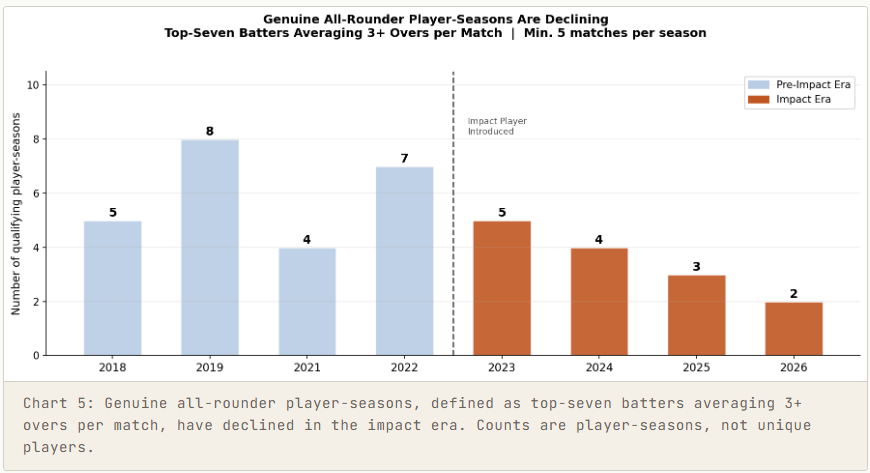
The number of qualifying genuine all-rounder player-seasons in the IPL top seven has fallen from an average of six per season in the pre-impact era to two in the partial 2026 season. The direction is consistent across every impact era year.
None of this yet appears in cricket’s development system. The sixteen-year-old in a Tamil Nadu academy deciding how to allocate training time will not read Cricsheet data. But they will read the IPL. They will watch which profiles get selected, retained, and actually used. If the world’s most influential T20 league is progressively reducing the tactical value it extracts from the bowling of top-seven batters, the message to every tier below is clear: the almost-all-rounder is a less valuable investment than it once was.
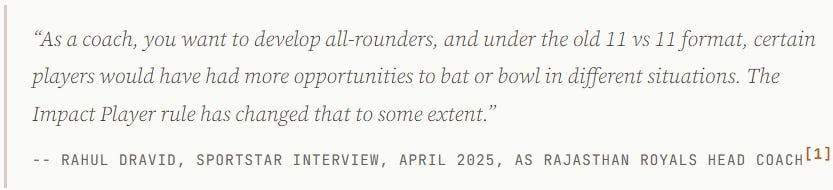
Over time, the selection signal becomes the development signal. Young players and their coaches will read it.
The hidden cost
The first two parts of this series documented what the Impact Player rule does inside a match. This part has documented what it does over time: the usage erosion that gradually makes the dual-skill cricketer structurally less necessary.
The finding is not that all-rounders are extinct. It is that the IPL has reduced the premium on one specific archetype: the top-seven batter who bowled enough to matter but not enough to be considered a frontline option. That player gave captains flexibility within a fixed bowling allocation. Under the Impact Player rule, that flexibility can be purchased through substitution. The almost-all-rounder is not being squeezed out by anyone’s intention. They are being made less necessary by the rule’s incentives.
That is the cost the scorecards do not show.
Parts 1, 2, and 3 have established the structural case, documented the behavioural consequence, and traced the usage erosion among top-seven batting roles. What remains is the verdict. The Impact Player rule has delivered three seasons of record scores and visible spectacle. But T20 cricket is attempting something more ambitious than one league’s entertainment numbers. It is attempting to become a global sport, with rules that travel, that do not require explanation, and that produce a game recognisable wherever it is played. The question is whether a rule serving one league’s short-term entertainment interest should be allowed to reshape a format cricket wants the world to understand. Part 4 makes the case that it should not, and argues for what should replace it.
Nihal Moidu · Cricket analyst · nihalmoidu.substack.com · @NihalMoidu_
References
[1] Rahul Dravid, Sportstar interview, April 2025, in his capacity as Rajasthan Royals head coach. Reported by SportsTak and Sportskeeda.
Methods note
Data and coverage: Ball-by-ball data from Cricsheet (cricsheet.org), accessed 18 May 2026. Data made available under the Open Data Commons Attribution Licence (ODC-BY). IPL seasons 2018 to 2022 (excluding 2020) and 2023 to 2026. 524 matches, 126,003 delivery records. BBL seasons 2018-19 to 2024-25, grouped by starting year (360 matches). T20 Blast seasons 2018 to 2025 (858 matches).
Definitions and classifications: Batting positions are derived from the order in which batters first appeared in each innings. Players who did not bat in a given innings are not assigned a position for that innings. Top-seven classification is applied at player-match level. Bowling figures are across both teams per match and use legal deliveries only. Role classification is at player-season level, minimum five matches. Thresholds: specialist batter (zero overs per match average), occasional part-timer (above zero to below one), secondary bowling batter (one to below three), genuine all-rounder (three or more). Player-season classifications are aggregated across all teams represented by that player in a given season.
Statistical tests and caveats: Welch two-sample t-tests compare match-level top-seven overs per match across pre and post periods. IPL decline p < 0.0001. BBL increase p < 0.0001. T20 Blast change p = 0.748, not significant. Role distribution charts are descriptive and not tested for statistical significance. 2026 IPL data covers 56 processed matches through 13 May 2026 and should be read as directional. Washington Sundar 2022 figure is based on 6 qualifying matches, above the minimum threshold of 5. Pre-impact top-seven overs figure of 8.3 overs per match differs from the 11.2 figure in Part 1 because that analysis used Misra’s full historical dataset from 2008; the 2018 to 2022 baseline here provides a more like-for-like comparison. The talent pipeline argument is a directional inference from the IPL’s selection signal, not a direct measurement of academy or development-system behaviour.