
The Succession Premium
Sometimes the future is ready. Sometimes it is only younger.

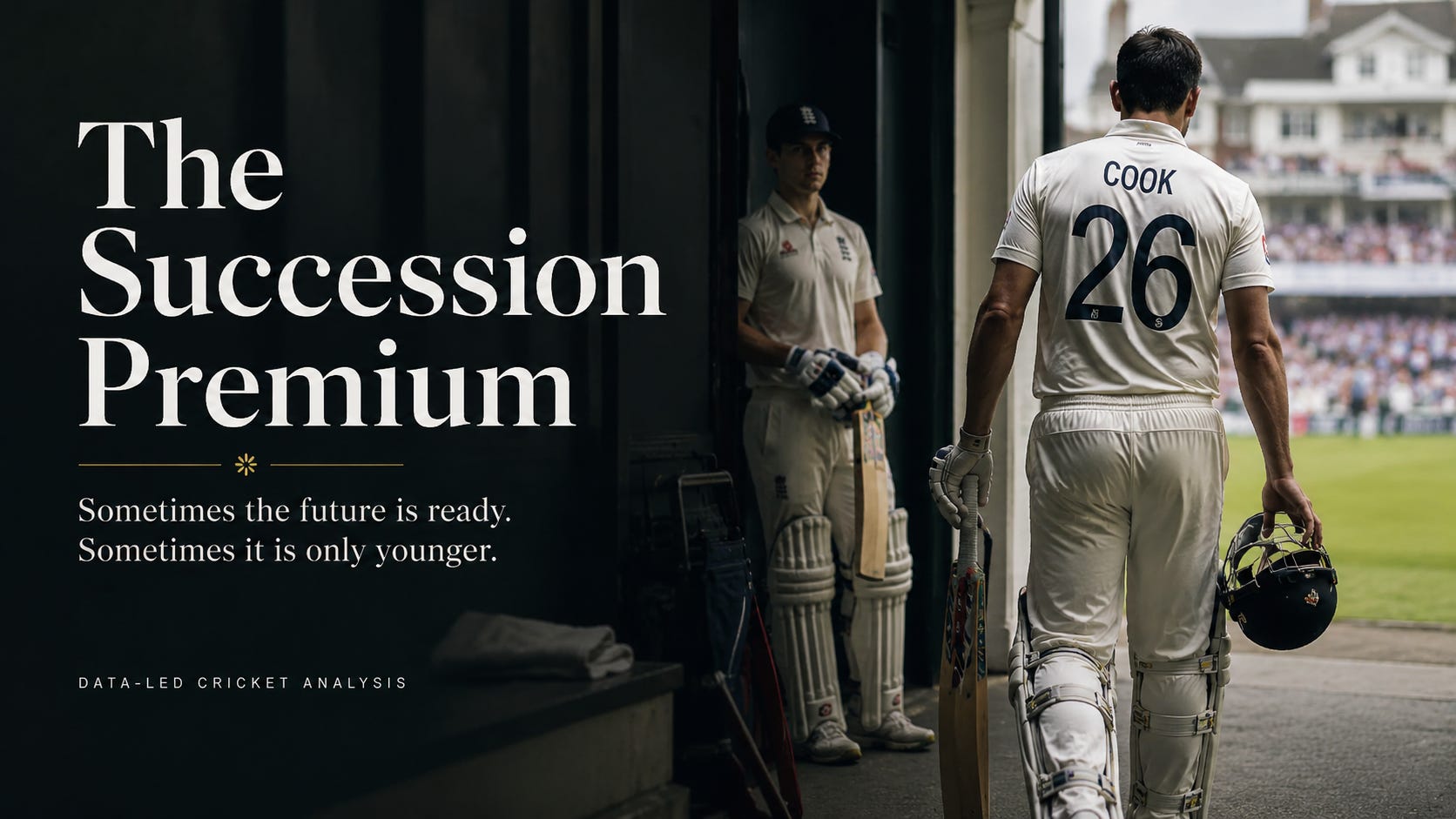
Selectors rarely say they are moving on from a player because he is old.
The language is usually softer. Planning for the future. Building toward the next cycle. Giving the next player time. Managing workload. Looking ahead.
Sometimes that is exactly right. International cricket is not a retirement gift. Teams have to move before decline becomes terminal. A great player’s past cannot be allowed to block a better future.
But there is another possibility.
Sometimes the future is overvalued because it has not failed yet.
That is the problem this analysis tries to measure. Not whether older players eventually decline. They do. Not whether teams should ever move on from them. They must. The narrower question is this: when teams replace established batters late in their international careers, how often does the successor group actually improve the immediate output?
Call it the succession premium: the price a team pays today for the promise of tomorrow.
The easy story is too simple
Cricket usually talks about ageing players in one of two ways.
The first is sentimental: a great player has earned more time. The second is managerial: sport moves on, and the future has to be built.
Both can be true in different cases. That is why the broad debate is unsatisfying. It treats succession as instinct, loyalty or courage, when the more useful question is empirical.
What did the outgoing player still provide? What did the successor group provide immediately afterward? How long did it take for the replacement pathway to catch up? And was the transition made because the older player had declined, or because the team wanted to get ahead of a decline it expected?
Those are different questions. They should not be collapsed into one argument about age.
What this analysis does, and does not, claim
This is a first evidence layer on established batter succession, not the final answer on all veteran succession.
Pace bowlers are excluded because their succession problem is different. For seamers, performance and availability cannot be separated: a bowler may remain dangerous when selected but become less able to carry the workload a team needs across a series or cycle. Spin bowlers are also outside this piece because their workload, injury risk, longevity and selection logic differ materially from pace bowlers.
This piece focuses on 26 established batter transitions across men’s Tests, ODIs and T20Is between 2005 and 2025. Those transitions come from 14 unique players. Some players appear in more than one format because a Test exit, an ODI exit and a T20I exit are separate selection decisions. Chris Gayle in Tests, ODIs and T20Is is not one transition counted three times. It is three different format careers with different team needs, roles and successor pools.
That distinction matters. The question is whether a team improved immediately after moving on from that player in that format.
The study base
For this analysis, I built a men’s international dataset from Cricsheet ball-by-ball files covering 1 January 2005 to 31 December 2025.
The retained study base contains 835 Tests, 1,853 ODIs and 1,056 T20Is. Afghanistan men’s matches are excluded because the primary source does not currently provide usable coverage for them. The Australia versus ICC World XI Test in 2005 is excluded because the opposition was not a Full Member national team.
The player comparison uses runs per innings as the primary batting measure. Batting average is retained in the case table, but it is not the primary metric because small 12-month windows can be distorted by not-outs. Runs per innings asks the simpler question: how much did this batting role actually produce per innings before and after the transition?
The outgoing player’s value is measured over a rolling final 12-month window, ending with his final match in that format. The successor group is measured over the first 12 months after that exit. This is a rolling window, not a calendar-year cut. For example, Alastair Cook’s Test window runs into September 2018 and includes both his 244 not out at Melbourne and his farewell 147 at The Oval.
Why the successor cannot be one name
The clean version of succession is simple: one player leaves, another player takes his place.
Cricket is rarely that neat. When a top-order batter exits, the team may try several players across two batting positions before one settles. The player who eventually succeeds may not be the first player selected after the exit.
That is why the main comparison here is outgoing player versus successor group.
Failed trials count. Short-term replacements count. Players who briefly absorb the role and then disappear count. The eventual successor cannot be allowed to erase the cost of getting there.
The first result: succession is not one story
The broad argument does not survive unchanged.
There is no evidence here for a sweeping claim that teams always move on from senior batters too early. In 15 of the 26 transitions, the successor group scored more runs per innings in the first 12 months than the outgoing player had in his final 12 months. In 11, the outgoing player still outperformed the successor group.
The split by format is more interesting.
Format-level split:
- Tests: 10 cases. Successor group higher in 4, outgoing player higher in 6. Mean change: +2.8 runs per innings. Median change: -3.7.
- ODIs: 13 cases. Successor group higher in 9, outgoing player higher in 4. Mean change: +9.0. Median change: +5.1.
- T20Is: 3 cases. Successor group higher in 2, outgoing player higher in 1. Mean change: +2.7. Median change: +5.0.
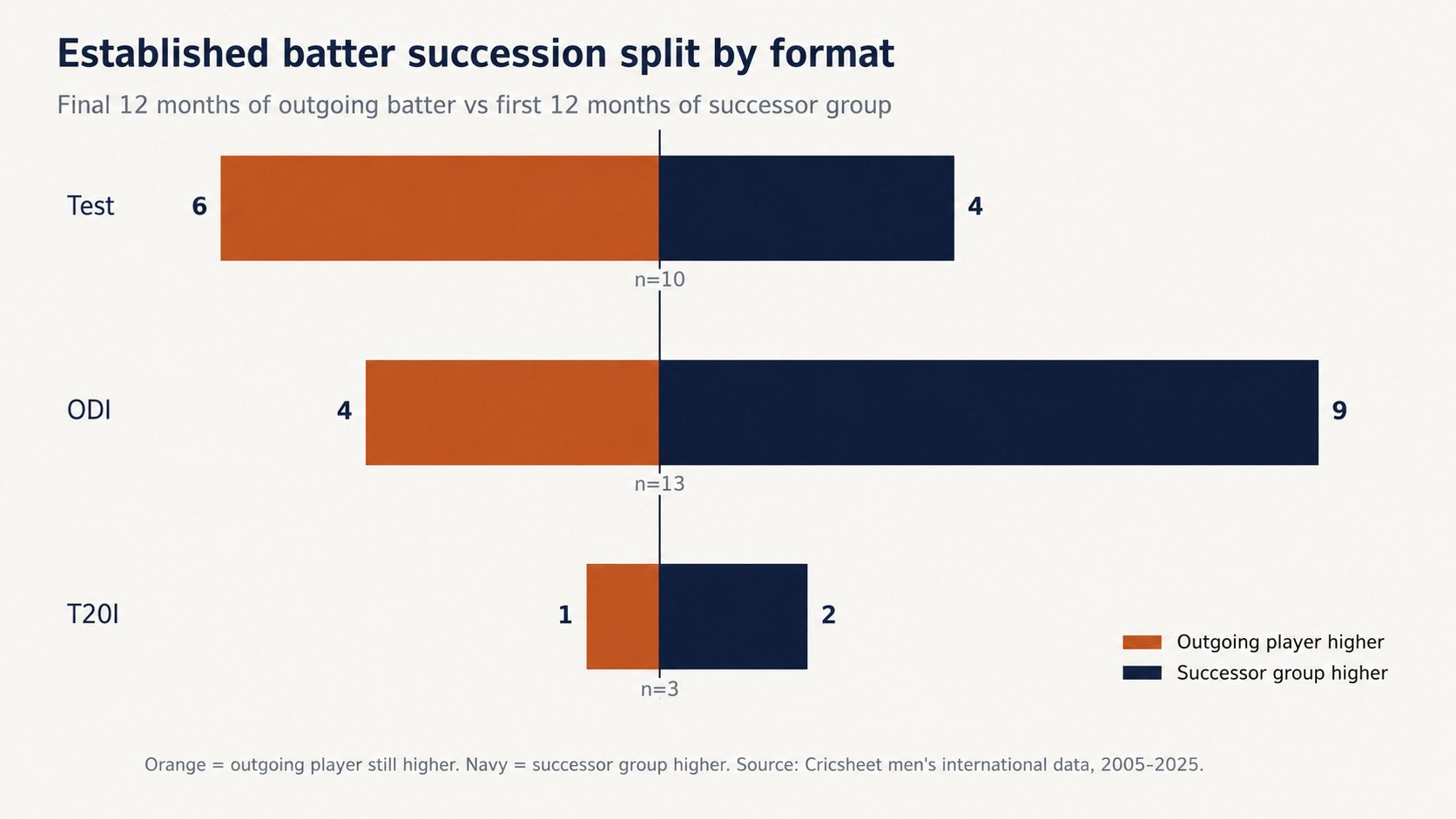
The data forced the argument to become narrower. I began with the suspicion that teams may often move on too early. The first result does not support that broad claim. ODI succession often looks efficient. The sharper problem is Test batting, where the immediate replacement pathway looks less reliable.
The T20I row is deliberately given less weight. It contains only three player-format transitions: Chris Gayle, Shikhar Dhawan and Ross Taylor. Gayle and Dhawan improved on immediate output. Taylor did not. His final T20I year produced 27.7 runs per innings, while New Zealand’s successor group produced 20.7. That is enough to keep the row in the evidence table, but not enough to build a format argument around it.
The point is not that selectors always get succession wrong. It is that succession cost is uneven, format-specific, and often hidden because cricket remembers the successor who eventually worked rather than the transition period that came before him.
ODI succession often looked cleaner
Several ODI transitions look efficient on the numbers.
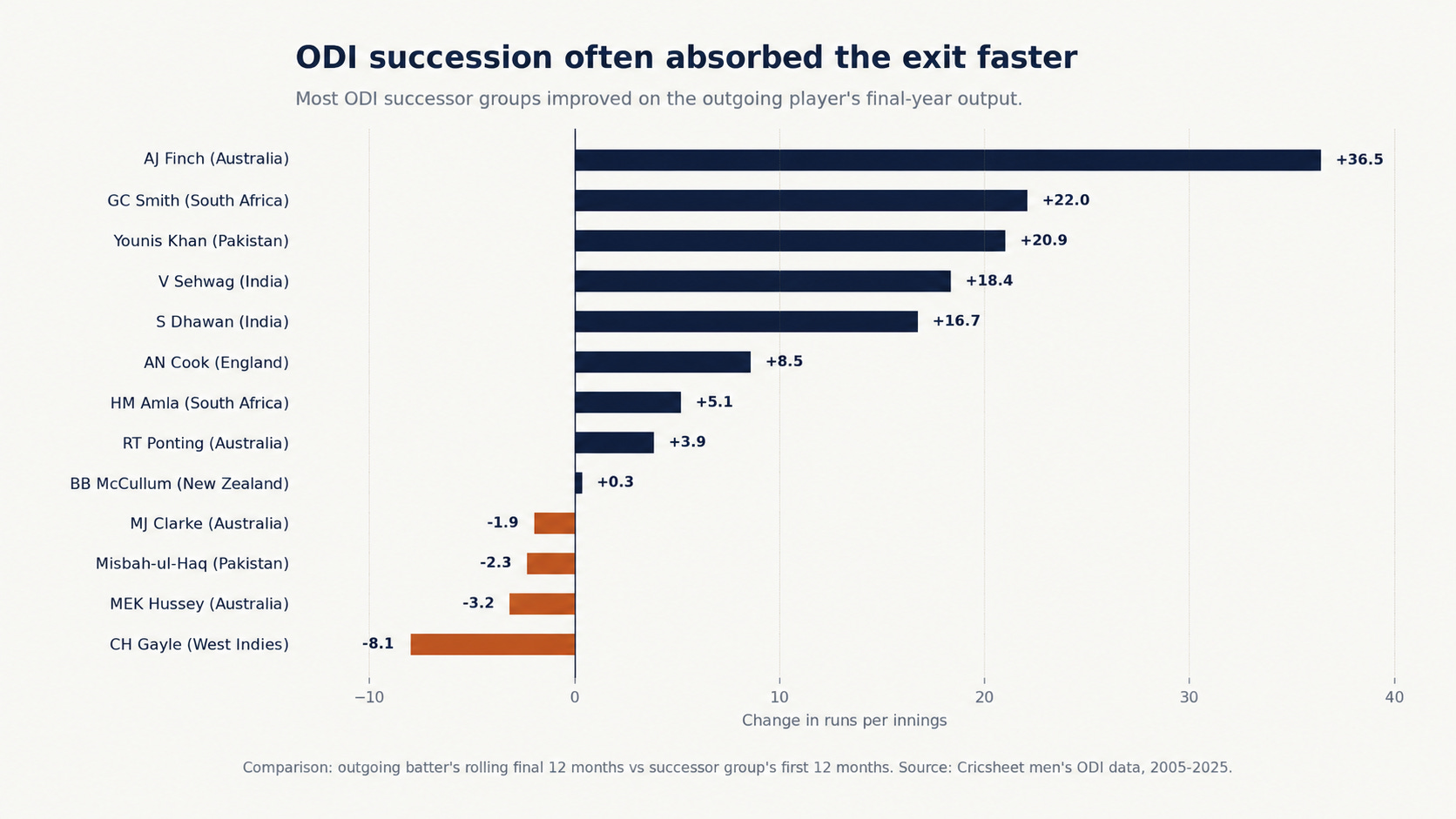
Aaron Finch’s final ODI year for Australia produced 12.4 runs per innings. The Australian successor group in the next 12 months produced 48.9. That is not a succession premium. That is a team moving on when the cost had already become visible.
Virender Sehwag’s final ODI year in this dataset produced 22.5 runs per innings. India’s successor group produced 40.9. Younis Khan’s final ODI year produced 21.1. Pakistan’s successor group produced 42.0. Shikhar Dhawan’s final ODI year produced 31.3. India’s successor group produced 48.0.
Those cases matter because they discipline the argument. A veteran’s name is not evidence. A great career does not prove a live selection case. Sometimes the numbers show that the team was right to move.
There are exceptions. Chris Gayle’s final ODI year for West Indies produced 53.3 runs per innings at a strike rate of 111.7. The immediate successor group produced 45.2 at a strike rate of 79.7. Mike Hussey and Misbah-ul-Haq also sit on the wrong side of the ODI ledger, though by narrower margins.
But the overall ODI pattern is still clear. Nine of the 13 ODI successor groups improved on the outgoing player’s final-year runs per innings. That does not prove every decision was right. It does show that white-ball succession often absorbed the exit faster than the sentimental version of the argument would predict.
Test transitions were less clean
The Test cohort looks different.
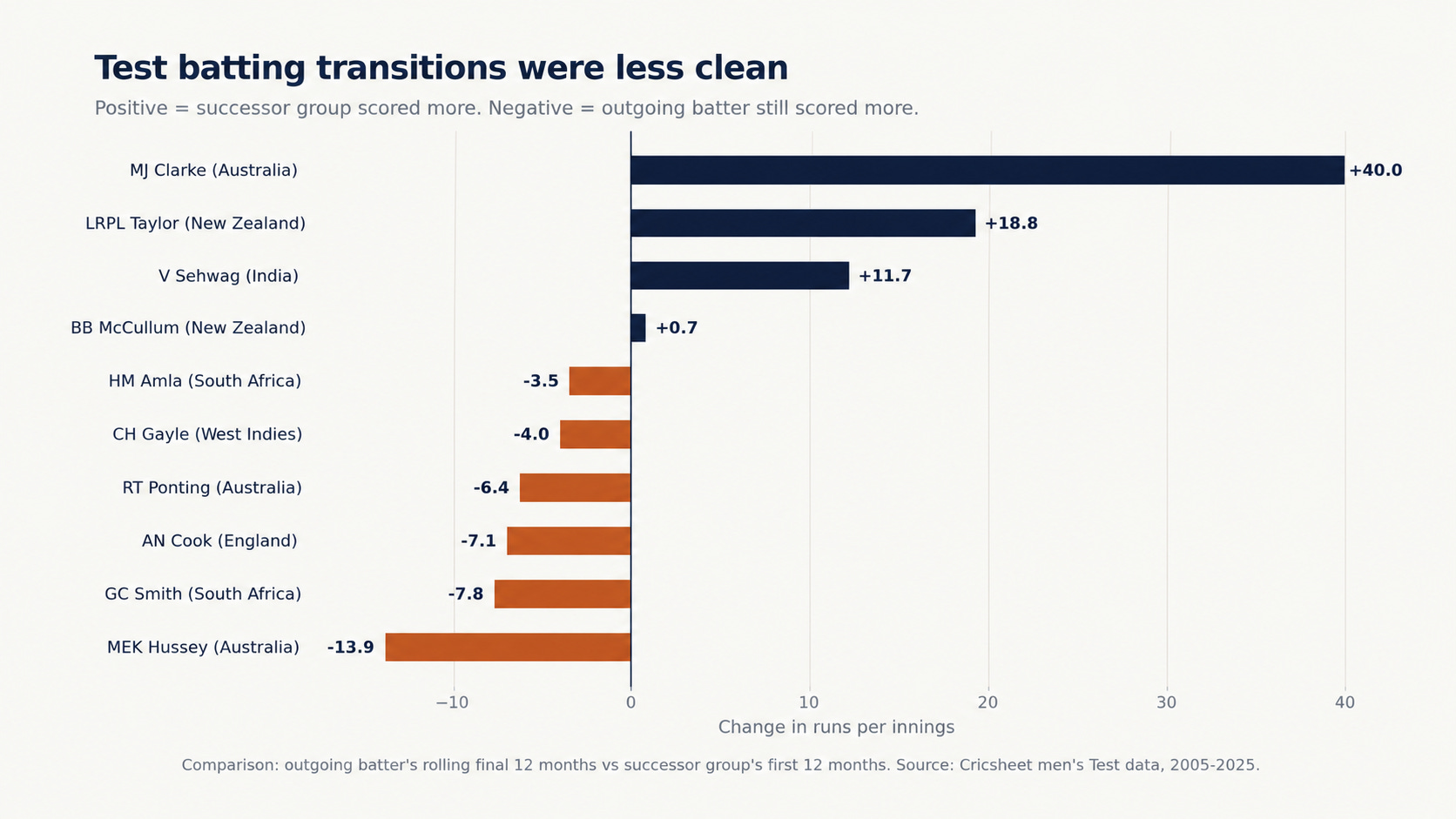
In six of the ten Test transitions, the outgoing player still produced more runs per innings in his final 12 months than the successor group produced in its first 12 months. The median change was negative: the successor group scored 3.7 fewer runs per innings than the outgoing player had in his final year.
That is not enough to declare a law. But it fits cricketing logic.
A Test batting role is not only a slot in the order. It is a method of survival, a relationship with conditions, an understanding of tempo, and a tolerance for repeated failure. A white-ball batting slot may be shaped more clearly by role, phase and tournament cycle. A Test batting slot is harder to replace cleanly.
Some Test transitions in the cohort were absorbed well. Michael Clarke’s final Test year had already fallen to 22.4 runs per innings, and Australia’s successor group produced 62.4. Virender Sehwag’s Test exit also improved on the immediate numbers. Ross Taylor’s Test exit was absorbed cleanly too: his final year produced 25.3 runs per innings, while New Zealand’s successor group produced 44.1. Brendon McCullum’s Test transition was almost neutral on runs per innings, and the successor group improved on average.
But several Test transitions show a real cost.
Mike Hussey’s final Test year for Australia produced 42.1 runs per innings and an average of 50.0. The Australian successor group in the first 12 months after his exit produced 28.2 runs per innings and an average of 30.8.
Ricky Ponting’s final Test year produced 41.1 runs per innings. Australia’s first-year successor group produced 34.6.
Graeme Smith’s final Test year produced 39.4 runs per innings. South Africa’s first-year successor group produced 31.6.
Alastair Cook’s final Test year produced 33.7 runs per innings. England’s successor group produced 26.6.
Hashim Amla is the uncomfortable middle case. His own final Test year had already fallen to 22.5 runs per innings, so this is not a simple argument that South Africa discarded a still-dominant batter. But the immediate successor group was lower still, at 19.1. That is exactly why succession is difficult to analyse. A player can be declining and still not be cleanly replaced.
None of these cases automatically proves the player should have continued. Some exits were retirements. Some were shaped by availability, motivation or team direction. But they show the performance cost that disappears when succession is discussed only as a future-planning exercise.
The future may have been right. The price was still real.
What the finding does not prove
This analysis does not prove that selectors acted because of age, that an outgoing player would have kept scoring at his final-year level, or that the eventual successor was wrong. It also does not treat all exits as selector-driven. Some were voluntary retirements, some were format decisions, and some were simply the natural end of an international career.
That is why the claim is deliberately narrower than the instinct that began the project. Succession costs exist, but not equally. In this first cohort, they appear easier to absorb in ODIs, more exposed in Tests, and too lightly sampled in T20Is to carry much weight.
The next layer would need exit reason, age, availability, role continuity and longer successor horizons. That matters especially for pace bowlers, where selection value is as much about durability as quality.
The real question
Every team needs succession. No serious argument says otherwise.
The question is whether succession is sometimes treated as too binary: keep or discard, veteran or future, past or next generation.
The best teams may not be the ones that move on earliest. They may be the ones that can separate decline from age, current value from reputation, future value from hope, and transition planning from transition theatre.
Sometimes the successor is ready. Sometimes the team pays a price and gets the future it wanted. And sometimes it pays the price without ever getting the return.
That is the succession premium.
Sometimes the future is ready. Sometimes it is only younger.
Nihal Moidu · Cricket analyst · nihalmoidu.substack.com · @NihalMoidu_
Methods and sources note
Except where stated, statistical findings are from original analysis of Cricsheet men’s international ball-by-ball data, 2005-2025. Afghanistan men’s matches are excluded because the primary source does not currently provide usable coverage for those matches. The Australia versus ICC World XI Test in 2005 is excluded because the opposition was not a Full Member national team.
The retained study base contains 835 Tests, 1,853 ODIs and 1,056 T20Is. The article analyses a first case cohort of 26 established batter transitions across 14 unique players. A transition is counted at player-format level, so the same player can appear more than once if his Test, ODI and T20I exits created separate format-specific succession events.
The outgoing player window is rolling, not calendar-year. It covers the 365 days before and including the player’s final match in that format. The successor window covers the first 365 days after the exit. For Alastair Cook’s Test case, this means the outgoing window includes his 244 not out in Melbourne in December 2017 and his farewell 147 at The Oval in September 2018.
The primary metric is runs per innings, calculated as runs divided by innings batted. Batting average is retained in the case table but is not the primary comparison because 12-month windows can be distorted by not-outs. Successor groups are constructed from players who absorbed the relevant batting-role space in the 12 months after the outgoing player’s final match. The method intentionally counts short-term trials and failed replacements rather than selecting only the eventual long-term successor.
This is not a complete census of every senior batting exit. It is a defined first case cohort used to test whether the succession-premium argument survives contact with evidence. The full 26-case table, code and processed data can be shared on request. The analysis does not infer selector intent unless supported by documented public evidence, and this article does not claim that age caused any individual decision.